Key takeaways: AI referral traffic to websites grew 16x between 2024 and 2026 (SE Ranking). LLMs answer questions by generating synthetic sub-queries nobody ever typed (a technique called query fan-out). Adding citations, statistics and quotations to your content can increase visibility in AI answers by up to 40% (Princeton et al., KDD 2024). This article covers what we know so far, and what to do about it.
Why does brand visibility on LLMs matter now?
Because the traffic (and the audience behind it) is growing faster than any other channel. The absolute numbers are still small. The trajectory is not:
- AI referral traffic grew 16x from 2024 to 2026, rising from 0.02% to 0.32% of total website traffic, across a sample of 101,574 websites (SE Ranking, AI Traffic Research Study, 2026).
- ChatGPT referrals grew 206% year over year (January 2025 vs January 2026), while domains receiving at least one ChatGPT referral jumped from 71,000 to roughly 260,000 (SE Ranking, 2026).
- ChatGPT reached 900 million weekly active users in February 2026, up from 400 million a year earlier (OpenAI, February 2026).
- AI-driven referrals to US retail sites surged 693% year over year during the 2025 holiday season and converted 31% better than non-AI traffic (Adobe Digital Insights, January 2026).
The conclusion is straightforward: being cited by LLMs is becoming a measurable acquisition channel, not a curiosity.
Why is GEO still an unsolved problem?
Because the target keeps moving. No agency or brand has yet developed a settled, repeatable capability for LLM visibility and to some extent, that is structural. The classification logic changes with every model release. More importantly, search logic must now chase phrases that no human has ever typed.
How do LLMs actually “search”? Query fan-out explained
LLM-based search engines do not search for the query the user typed. They decompose it. Google’s AI Mode uses a technique called query fan-out: an LLM breaks the user’s question into a series of synthetically generated sub-queries, retrieves results for each in parallel, and synthesizes one answer (Search Engine Journal, 2025).
A concrete example. Mike King of iPullRank illustrates it this way: a search for “best sneakers for walking” may be silently expanded into sub-queries such as “best sneakers for men”, “best sneakers for walking in different seasons”, or “sneakers for walking on a trail” (Digiday, 2025).
And at scale. Google’s Deep Search pushes the same technique further, issuing potentially hundreds of background searches for a single question (Search Engine Journal, 2025).
The implication for brands: your content no longer competes on the keyword the user typed. It competes on dozens of machine-generated variations nobody ever searched for. The work shifts from ranking for a query to being the most citable source across an entire cluster of related intents.
How do you write content that LLMs cite?
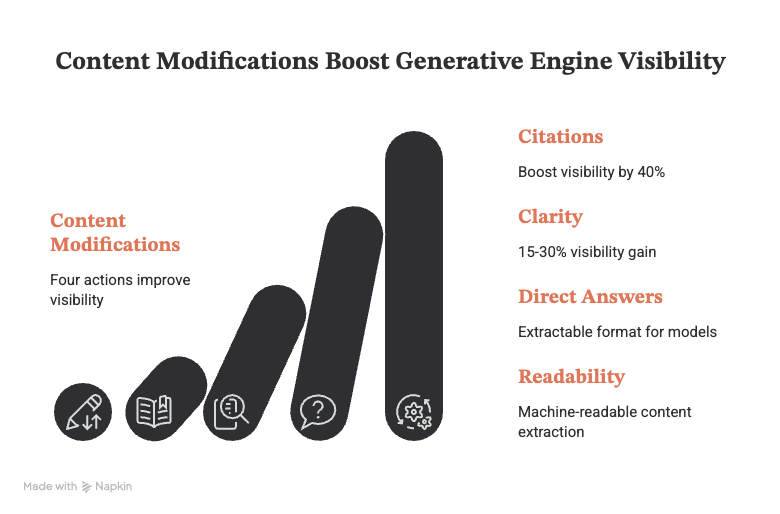
The most reliable evidence comes from the foundational academic study on GEO (Aggarwal et al., Princeton University / Georgia Tech / Allen Institute for AI / IIT Delhi, presented at KDD 2024), which tested content modifications across 10,000 queries. Four actions stand out:
- Cite your sources. Adding citations, credible quotations and relevant statistics boosted visibility in generative engine responses by up to 40%, the strongest lever measured in the study.
- Write clearly. Stylistic improvements to fluency and readability alone produced a 15–30% visibility gain. Models cite what they can parse and attribute with confidence; dense prose works against you.
- Answer real questions, directly. Structure content around the actual intents behind a topic (the sub-queries a fan-out system would generate) not around a single head keyword. Question-based headings followed by a direct answer are the most extractable format.
- Make content machine-readable. Short, self-contained paragraphs, structured data and clean information architecture let retrieval systems extract, verify and attribute your claims without surrounding context.
FAQ
What is GEO? Generative Engine Optimization is the practice of structuring content and brand presence to earn citations inside AI-generated answers from ChatGPT, Google AI Mode, Perplexity, Gemini and Claude.
Is GEO different from SEO? Yes. SEO optimizes for ranking on a typed query; GEO optimizes for being cited across the synthetic sub-queries an LLM generates. The two overlap on content quality but diverge on structure and format.
Where should a brand start? With its highest-traffic pages: add named sources, statistics and quotations; break long paragraphs into self-contained answers; rebuild headings around the real questions users ask.
These are a couple of reflections on where we currently stand with GEO. This can only be a starting point, but thinking hard about content quality is never the wrong bet. And yes: this article is structured exactly the way it recommends.
Sources: SE Ranking, AI Traffic Research Study, 2026; OpenAI, February 2026; Adobe Digital Insights, January 2026; Digiday / iPullRank, 2025; Search Engine Journal, 2025; Aggarwal et al., “GEO: Generative Engine Optimization”, KDD 2024.
Leave a Reply